




days
hours
minutes
seconds
Tickets

EARLY FULL PASS 75€



No cON Name congress (2026)
No cON Name is the oldest active hacking and IT security conference in Spain. Established in 1999, the first edition took place in Mallorca, and we are back to Mallorca. We are a non-profit association. Our events are open to anyone eager to share knowledge and engage with our vision of Hacking and IT Security (aka Cybersecurity). Here you can learn with no commercial bias, no sponsors (as much as possible) and meet people confortably. We thrive thanks to the support of our participants, we take pride in being one of the most independent conferences
Organization
With the collaboration of:
Singularities
Cybersecurity Track
Within the frame of reference where we are located, we can boast of being the most avant-garde, traditional and independent conference.
For several editions (2), we have wanted to open ourselves to the rest of the world using English as a unifying tool. We invite everyone come to our conference and Barcelona. On the other hand, we have not ruled out our mother tongues, which will always be part of our identity.
Join Cybersecurity Track
The second and third days of the conference will be dedicated to this track. The event consists of two days full of talks, and forum discussion in CAT/ES/ENG languages.The final list will be published in this section on October, the 20th, meanwhile we will be publishing bits of information about talks and speakers.
Accepted speakers

Bypassing 802.1x network authentication by hijacking IP and MAC in Ethernet environments
Marcin Ochab
Researcher, penetration tester, red team operator, and security consultant at LevelBlue SpiderLabs. I am also a cybersecurity lecturer at the University of Rzeszów in Poland and the discoverer of several CVEs mostly on leading ERP systems. Ph.D. in computer science from the AGH University of Science and Technology and am an automation and robotics engineer. https://www.ur.edu.pl/pl/pracownik/strony-pracownicze/marcin-ochab
Unlocking cars with Proxmark3: Turning an RFID Research Platform into an active LF transmitter for PKES attacks
Joel Serna Moreno

You Deleted the User. Their Data Didn’t Die.
Marília Rocha
Marília Rocha, known as malwarilia, is a Privacy Engineer and Application Security professional based in Porto, Portugal. Her work sits where software architecture, security and personal data meet: understanding how applications collect and move data, finding the places where security controls and privacy requirements overlap, and helping engineering teams build systems that are easier to secure and easier to reason about. Vulnerability Management is an important part of her background, and it shapes how she approaches privacy. She tends to treat privacy problems the way vulnerabilities are treated: as issues with technical root causes that need owners, evidence and follow-up, not only policy statements. Her experience also covers Web Security, DevSecOps, security risk and GRC, and she takes part in bug bounty programs
Recovering a Proprietary Building Intercom Protocol with Consumer-Grade Hardware
Kirils Solovjovs
Kirils Solovjovs is Latvia's leading white-hat hacker and IT policy activist. He began programming at age 7, and by grade 9 was already writing machine code directly in a hex editor during lunch breaks. Renowned for uncovering and responsibly disclosing critical vulnerabilities in national and international systems, he is an expert in network flow analysis, reverse engineering, and social engineering. A lifelong command-line enthusiast, he uses bash daily for hacking, automation, and large- scale data processing. He is the author of the jailbreak tool for MikroTik RouterOS and played a pivotal role in developing e-Saeima, the world's first fully remote legislative system used by the Latvian Parliament. Today, Kirils serves as lead researcher at Possible Security
Your Travel eSIM Is Talking Behind Your Back
Pedro Cabrera and Javier Valero
Pedro Cabrera is an Industrial Engineer and cybersecurity researcher specialized in telecommunications security and mobile network hacking. He has more than 20 years of experience in telecommunications and security research, with a particular focus on 2G/3G/4G/5G networks, SIM/eSIM security, SDR and telecom penetration testing. Pedro is the CEO of Ethon Shield, a cybersecurity company specialized in telecommunications security, where he leads security assessments and research involving mobile networks, RAN, core networks, SIM/eSIM technologies and private 5G environments.

Camarada, están espiando tus paquetes - ТСПУ al descubierto
ReD
- * Divulgar la arquitectura física y el funcionamiento técnico.
- * Analizar el marco legal
- * Presentar y explicar las contramedidas
- * Abrir un debate sobre las implicaciones para Europa.
También aportar documentación sobre un sistema real de DPI desplegado a escala nacional, con conocimiento aplicable tanto en investigación y evasión como en detección de patrones de tráfico (fingerprinting, throttling), y técnicas de ofuscación reutilizables más allá del caso ruso.
A organizaciones públicas y privadas les proporciona contexto legal y técnico para anticipar el impacto de futuras exigencias regulatorias sobre infraestructura de telecomunicaciones. Para la sociedad civil, aporta una comprensión accesible de cómo puede filtrarse o limitarse el acceso a la información sin que resulte evidente para el usuario final, junto con herramientas prácticas para identificar y sortear este tipo de censura. Y desde el punto de vista académico y de investigación en derechos digitales, constituye un caso de estudio concreto que conecta ingeniería de redes, legislación y política tecnológica
Ponente anónimo

Breathtaking PTRACE (Damn Vulnerable Medical Device)
Tamás Bőhm
Security architect working on haemodialysis machines. He have been in cybersecurity for a decade, eight years of it in offensive security, and have spent most of career around embedded devices, IoT, automotive and medical. I’ve mainly presented at Central European conferences such as HEK.SI and INFOSEK, but also had the chance to speak at OpenSUSE.Asia Summit 2024.
Villages
Hacking Village will be proposed by staff, but final format will be closed by both parts (staff and leader). The main purpose is, one more time, show and share skills / techniques in some areas and not to show commercial products and services.
You'll be able to enjoy villages if you are enrolled in Cybersecurity Track.
The final list, requirements, and room names will be published in this section on October, the 20th, meanwhile we will be publishing bits of information.
Village: INICIACIÓN AL HARDWARE HACKING DESDE 0
Leader: David Reguera Garcia
Durante el curso de 4 horas aprenderemos a utilizar el Bus Pirate v6 como herramienta de hardware hacking y trabajaremos directamente con hardware real:
- Cómo utilizar Bus Pirate v6
- Uso de analizador lógico
- Introducción práctica a SPI
- Introducción práctica a I²C
- Cómo identificar y comunicarnos con chips
- Dumpear memorias I²C y SPI
- Flashear/escribir memorias
- Lectura, modificación y escritura de datos
La idea es que al terminar puedas coger una placa, conectar el Bus Pirate y empezar a trastear con hardware de verdad.
Material de aprendizaje cedido en préstamo para 12 personas
Si alguien quiere comprarse el material puede traerlo:
HARDWARE NECESARIO
- Bus Pirate v6
https://dirtypcbs.com/store/designer/details/ian/6667/bus-pirate-6-rp2350b-with-enclosure?ref=buspirate.com
- Bus Pirate Probe Cable Kit
https://dirtypcbs.com/store/designer/details/ian/6619/bus-pirate-5-probe-cable-kit
- Bus Pirate Auxilary Cable Kit
https://dirtypcbs.com/store/designer/details/ian/6620/auxilary-cable-kit
- Cable USB C - Selecciona: 0.5m
https://www.amazon.es/SUNGUY-trenzado-transferencia-Android-compatible/dp/B0B2JZXW8L/
- Cable USB 2.0 A a Mini USB B - Selecciona: 0.2
https://www.amazon.es/dp/B07FW69HNT
- Analizador lógico
https://amzn.eu/d/00evkMDC
- Kit Cables Dupont - Selecciona: 1set 10CM
https://es.aliexpress.com/item/1005007072081464.html
- I2C EEPROM AT24C256 - Selecciona: Color: AT24C 256
https://es.aliexpress.com/item/1005009134670156.html
- SPI FLASH W25Q64 - Selecciona: Color: W25Q64 64Mbit
https://es.aliexpress.com/item/1005012354398183.html
- PCB clip 6p 2,54mm - Selecciona: Color: 6P single
https://es.aliexpress.com/item/1005005502613697.html
SOFTWARE NECESARIO
- Windows 11 instalado de forma nativa
Es obligatorio utilizar Windows 11 instalado directamente en el ordenador.
No se admitirán:
X Máquinas virtuales
X Otros sistemas operativos
X Entornos virtualizados
Programas que debes instalar previamente
- Logic 2 for Windows
https://www.saleae.com/downloads
- Tera Term
https://github.com/TeraTermProject/teraterm/releases
Offensive hardware hacking & firmware dev, OS internals, C/C++, assembler, reversing, forensics, x86_64, AVR, ARM, PIC. Ex malware researcher
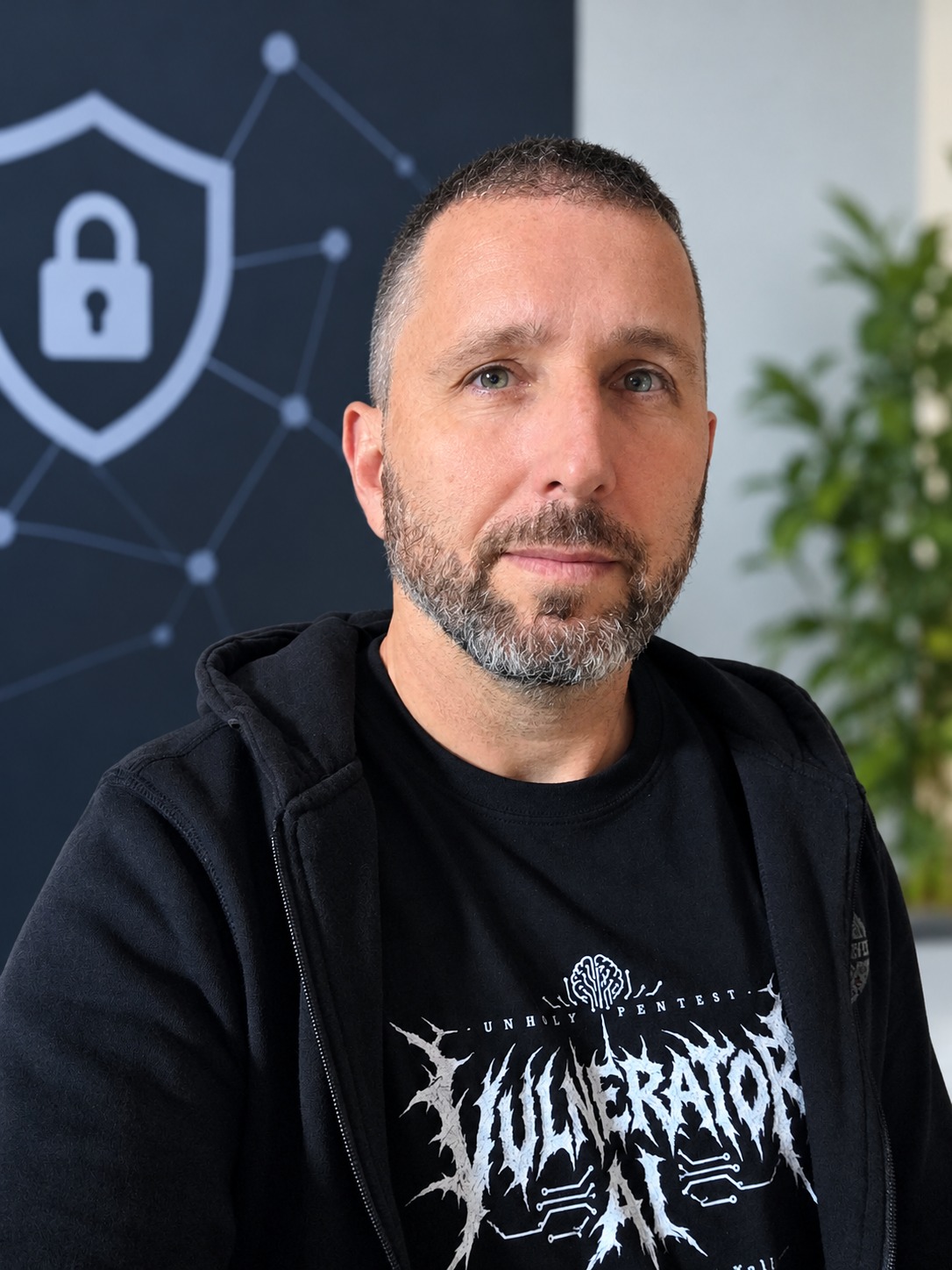
Village: Hands-On Pentesting-AI: Automatización de análisis de pentest con IA
Leader: Sergio Jimenez Narbona
Vulnerator-AI integra modelos de lenguaje de Inteligencia Artificial en el ciclo de vida del pentest para automatizar desde el reconocimiento hasta la generación de pruebas de concepto (PoC) y reportes ejecutivos. En este taller práctico/demo, los asistentes aprenderán a utilizar Vulnerator-AI para automatizar el flujo de trabajo de un pentester: ingesta de escaneos, priorización inteligente de objetivos, toma de decisiones asistida para la fase de explotación y redacción automatizada de hallazgos.
Objetivo: Romper el hielo, alinear conceptos y asegurar que todo el mundo tenga el entorno listo para trabajar.
Bloque 1: Configuración, Fundamentos y Arquitectura
- -Bienvenida al Village y Dinámica
- -Arquitectura e Ingesta de Datos (Breve Demo Teórica)
- Despliegue Asistido (Checklist Técnico)
- El Ciclo de Pentesting Ofensivo Asistido por IA
Bloque 2: El Ciclo de Pentesting Ofensivo Asistido por IA
- -Práctica 1: Triaje Inteligente y Priorización
- -Práctica 2: Explotación y Generación de PoCs
Bloque 3: Automatización de Reportes, Ética y Retos Abiertos
- -Automatización de Informes y Remediación
- -Consideraciones Éticas y Privacidad
- -Reto Libre, Cierre y Hoja de Ruta
Schedule
Interesting Places around / How to arrive?

Interesting Places around Parc Bit

Where we are?
